

In Indian hospitals, stretch (performance) scrubs outlast cotton scrubs. Cotton absorbs sweat, fades faster and shrinks under the hot-water and high-heat drying cycles common in Indian laundries. Performance blends — like the rayon-polyester-spandex used in Alleda UltraFlex — resist abrasion, hold colour and recover their shape wash after wash. For heat, humidity and long shifts, stretch scrubs deliver a lower cost-per-wear and a longer usable life.
Stretch scrubs last longer than cotton scrubs in Indian clinical settings. Cotton is prone to shrinkage, fading and slower drying in heat and humidity, while performance blends resist wear and retain shape and colour across repeated hot-wash cycles — giving Indian nurses, doctors and physios more shifts per garment and better all-day comfort.
Why fabric choice matters more in India
Indian wards run hot. Air-conditioning is inconsistent, shifts routinely stretch past 10 hours, and laundering is aggressive — hot water, strong detergents and high-heat drying. That combination is exactly what wears cotton down: heat and moisture drive shrinkage and gradual colour loss, and the fibre weakens with frequent washing. The fabric that survives an Indian hospital is the fabric built for heat, sweat and repeat laundering.
88% of surveyed healthcare workers reported excessive sweating on shift, with median workplace heat (wet-bulb globe temperature) in India measured at 30.2°C — well into the range where moisture-managing fabrics matter. (Lee et al., 2020, Int. J. Environ. Res. Public Health)
When four in five clinicians are sweating through their shift, a fabric that holds water against the skin — as cotton does — works against them. A blend that wicks moisture and dries quickly keeps the wearer cooler and the garment lasting longer.
Cotton vs stretch scrubs: head-to-head
Here is how the two fabric types compare on the factors that actually decide how long a scrub survives in an Indian hospital.
| Factor | Cotton scrubs | Stretch / performance scrubs |
|---|---|---|
| Abrasion & wear | Fibres weaken with frequent washing | Higher abrasion resistance, longer usable life |
| Colour retention | Fades gradually under strong detergents | Holds colour across repeated hot washes |
| Shrinkage | Shrinks with hot water & high-heat drying | Dimensionally stable, keeps its fit |
| Moisture & drying | Absorbs sweat, stays damp, dries slowly | Wicks moisture, dries fast, stays cooler |
| Shape & recovery | Can bag out at knees and elbows | 4-way stretch recovers to shape |
| Cost-per-wear | Lower upfront, replaced sooner | Higher upfront, lower long-term cost |
The one thing cotton does well
Cotton feels soft and breathable straight out of the packet, and that first-wear comfort is real. The problem is durability: that softness comes from a fibre that loves water, and in a hot, high-laundering environment it fades, shrinks and thins faster than a performance blend. Modern stretch fabrics now match cotton's next-to-skin comfort while solving its weaknesses.
The Alleda answer: UltraFlex and PrimaFlex
Alleda builds only performance scrubs — no cotton-based lines — because cotton doesn't hold up to Indian clinical demands. Both Alleda lines are engineered for heat, movement and repeat laundering, at two price points.
| UltraFlex (Premium) | PrimaFlex (Everyday) | |
|---|---|---|
| Fabric | Rayon + Polyester + Spandex tri-blend | 180 GSM polyester blend |
| Stretch | 4-way stretch, full recovery | Functional everyday stretch |
| Best for | High-demand shifts, ICU, theatre, physio mobility | Daily wards, OPD, students, dependable rotation |
| Feel | Softest drape, superior moisture-wicking | Structured, reliable, easy-care |
| Positioning | Top-tier comfort & durability | Accessible entry into the Alleda range |
The rayon in UltraFlex is deliberate: it gives the tri-blend a soft, breathable drape and strong moisture-wicking, which is why it performs in hot wards where a stiff synthetic would feel clammy. PrimaFlex keeps the performance essentials — durability, colour retention, easy care — at an everyday price.
How to choose scrubs that last in Indian hospitals
Five checks that separate a scrub that survives a year of shifts from one you replace in three months.
Check the fibre blend, not just the feel
Look for a rayon-polyester-spandex or polyester-based blend over 100% cotton. A blend gives you abrasion resistance, colour retention and moisture-wicking that cotton can't match in a hot, high-wash environment.
Confirm true stretch and recovery
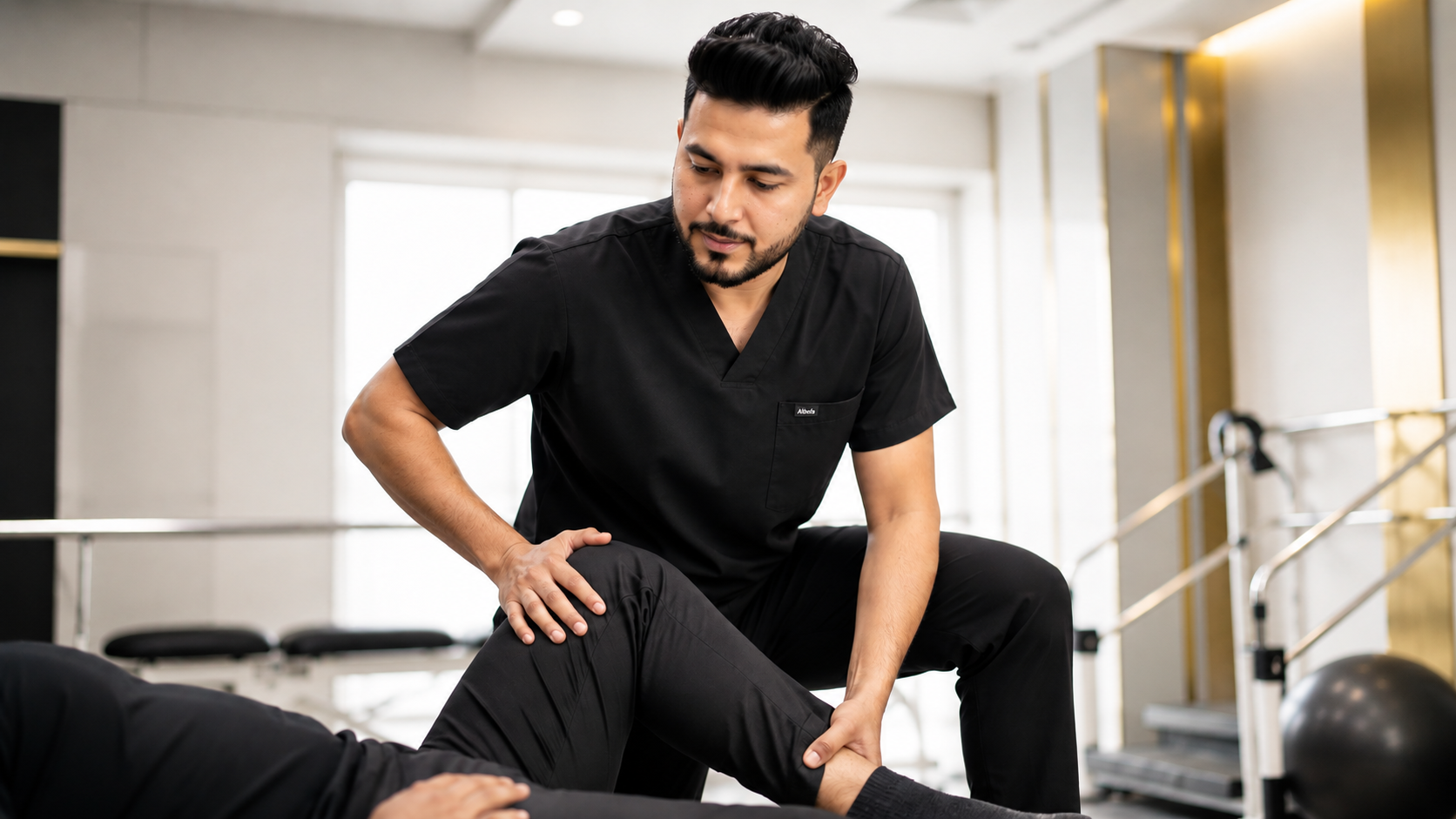
4-way stretch matters for physios and anyone squatting, lifting or reaching all shift. Just as important is recovery — the fabric should snap back to shape, not bag out at the knees and elbows.
Test for heat and moisture management
In Indian conditions, a quick-drying, moisture-wicking fabric keeps you cooler and cuts the damp-cloth feeling of a long shift. Cotton holds sweat; performance blends move it away from the skin.
Judge on cost-per-wear, not sticker price
Divide the price by the number of shifts you will realistically get. A performance scrub that lasts twice as long is cheaper per wear than a cheap cotton set you replace every quarter.
Match the line to the shift
Choose UltraFlex for high-demand, mobility-heavy roles and PrimaFlex for dependable daily rotation. Owning both lets you rotate garments and extend the life of every set.
"In my clinics I see the same thing every year — cotton scrubs come in soft and go out faded, shrunk and thin within a few months of Indian laundering. Performance fabric isn't a luxury here; it's what keeps a scrub usable, professional and comfortable across a full year of hot-ward shifts."
— Dr. Tanmay Kumar, DPT, Founder of Alleda Scrubs & Head of Department, Capri Institute of Manual TherapyBuilt to outlast the shift
Explore Alleda's performance scrub sets — premium UltraFlex or everyday PrimaFlex.
Shop UltraFlex Shop PrimaFlexFrequently asked questions
Are cotton or stretch scrubs better for Indian hospitals?
Stretch scrubs are better for Indian hospitals. Cotton absorbs sweat, dries slowly, shrinks in hot washes and fades faster, while performance blends wick moisture, resist abrasion and hold colour and shape. In India's heat, humidity and aggressive laundering, stretch fabrics give clinicians longer garment life and better comfort.
Do stretch scrubs really last longer than cotton?
Yes. Performance blends resist abrasion and shrinkage and retain colour across repeated hot-water washes, whereas cotton fibres weaken, fade and shrink with frequent high-heat laundering. Over a year of shifts this means fewer replacements and a lower cost-per-wear for stretch scrubs than for cotton ones.
Why does cotton fade and shrink so fast in Indian laundries?
Cotton is hydrophilic, so it absorbs water and reacts to heat. Indian laundering typically uses hot water, strong detergents and high-heat drying, which drives shrinkage and gradual colour loss. Performance blends are hydrophobic and dimensionally stable, so they hold their fit and colour far better under the same conditions.
Is UltraFlex made of cotton?
No. Alleda UltraFlex is a rayon-polyester-spandex tri-blend with 4-way stretch. The rayon provides soft drape and strong moisture-wicking, the polyester adds durability and colour retention, and the spandex delivers stretch and recovery — a combination built for hot wards, not the water absorption of cotton.
Should I buy UltraFlex or PrimaFlex?
Choose UltraFlex for high-demand, mobility-heavy roles such as ICU, theatre and physiotherapy, where premium comfort and durability matter most. Choose PrimaFlex for dependable daily ward and OPD wear at an accessible price. Many clinicians own both to rotate garments and extend the life of every set.
About the author — Dr. Tanmay Kumar, DPT
Dr. Tanmay Kumar is a physiotherapist and the founder of Alleda Scrubs. As Head of Department at the Capri Institute of Manual Therapy, he has trained more than 4,000 physiotherapy professionals across 100+ workshops. He founded Alleda to bring clinically-informed fabric engineering and fit to Indian medical apparel.



Share:
Best Medical Scrubs for Physiotherapy in India (2026)