

Scrubs for Men: The 2026 Buying Guide for Indian Healthcare Professionals
The best scrubs for men combine a breathable, stretch fabric, a tailored fit that moves with you, secure and well-placed pockets, and colours that survive repeated hot-water laundering. For Indian doctors, nurses and physiotherapists working long ward shifts, fabric performance and fit matter more than styling — those two decisions determine comfort, mobility and how long a pair actually lasts.
The short answer
Prioritise fabric first (a rayon-polyester-spandex tri-blend with 4-way stretch for demanding shifts, or a sturdy 180 GSM polyester blend for everyday wear), then fit, then pockets. Match the colour to your hospital's colour-coding policy, and size by chest and inseam rather than generic S–XL labels.
What to look for in men's scrubs
Men's scrubs are not just smaller or larger versions of a generic uniform. A scrub that performs through a real clinical day has to handle sweat, constant movement, frequent washing and the weight of the tools you carry. Six factors decide whether a pair works for you:
- Fabric and breathability — how well it manages heat and moisture across a shift.
- Fit and cut — tailored through the shoulders and torso without restricting movement.
- Pocket engineering — enough secure storage, placed where you actually reach.
- Colourfastness and durability — survives industrial or hot-water washing without fading or seam failure.
- Colour-code compliance — matches your department or hospital's dress policy.
- Sizing accuracy — fits Indian body proportions and is true to a published size chart.
India's clinical workforce is large and growing — the WHO's State of the World's Nursing 2025 report records over 3.3 million nurses registered with the Indian Nursing Council, working alongside lakhs of doctors and allied-health professionals. Most of them spend the bulk of their working life in one garment, which is exactly why getting these six factors right is worth the effort. (Source: Indian Nursing Council, WHO SoWN 2025.)
Fabric: the decision that defines everything
Fabric is the single most important choice in men's scrubs, and it is where most cheap scrubs fail. In a hot, humid Indian ward, a fabric that traps heat becomes uncomfortable within the first two hours. A fabric with no stretch fights you every time you bend, lift or reach. And a fabric that pills or fades after ten washes is a false economy.
There are two sensible routes. A rayon-polyester-spandex tri-blend gives you the best of three properties: rayon for softness and breathability, polyester for structure and colour retention, and spandex for 4-way stretch. A polyester blend at around 180 GSM is the dependable everyday alternative — structured, colourfast and easy to maintain, at a more accessible price. Both beat thin, low-grade cotton-poly mixes that wrinkle and wear out quickly.
UltraFlex vs PrimaFlex: which Alleda fabric is right for you?
Alleda Scrubs builds two distinct men's lines so you can match the fabric to your shift. Here is how they compare:
| Feature | UltraFlex (Premium) | PrimaFlex (Everyday) |
|---|---|---|
| Fabric | Rayon + Polyester + Spandex tri-blend | 180 GSM Polyester blend |
| Stretch | 4-way stretch | Structured, light give |
| Moisture management | Superior wicking and drape | Reliable, breathable |
| Best for | High-demand shifts: ICU, OT, emergency, physio | OPD, day wards, students, everyday duty |
| Feel | Soft, premium hand-feel | Crisp and durable |
| Price point | Premium | Mid-range |
If you spend most of your day on your feet under physical and thermal load, UltraFlex is built for that demand. If you want a dependable, well-made everyday scrub at an accessible price, PrimaFlex is the practical starting point. Neither is "better" — they are built for different shifts.
Fit and cut for the male physique
A good men's scrub is tailored through the shoulders and chest without becoming tight, and tapered through the body without restricting the deep bends and reaches that clinical work demands. Boxy, tent-like scrubs look unprofessional and catch on equipment; over-fitted ones split at the seams during transfers and CPR.
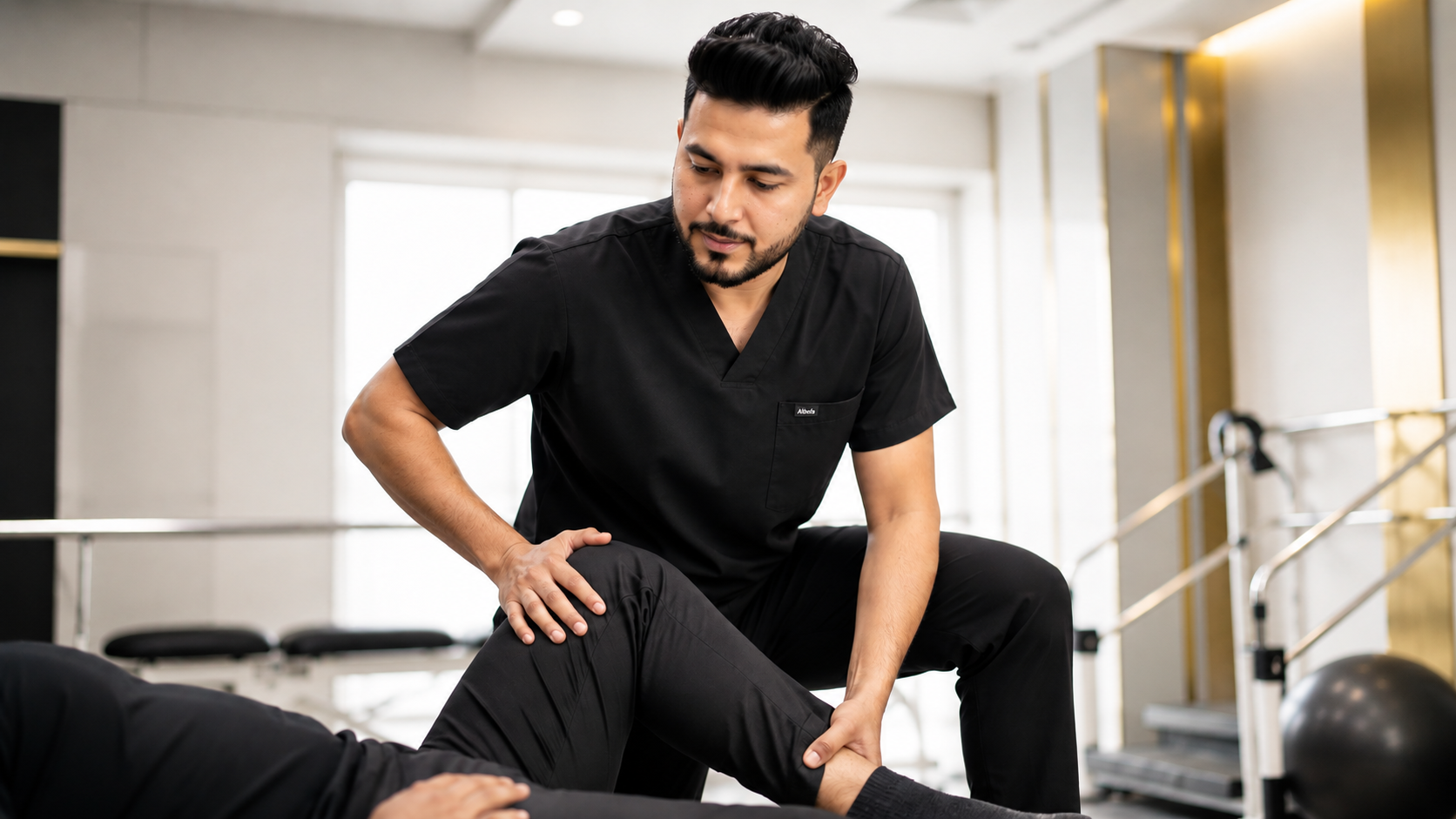
Look for a modern athletic cut with set-in or raglan sleeves that allow full overhead reach, a top length that stays tucked or sits cleanly at the hip, and trousers with a comfortable rise and a drawstring plus elastic waistband for an adjustable, secure fit through a moving day. Articulated knees on the trousers are a real advantage for physiotherapists and anyone doing floor-level or bedside work.
Pocket engineering for clinical shifts
Pockets are where scrubs are won or lost. The goal is secure, reachable storage for the tools you carry every day — not the highest number printed on a label. Most male healthcare professionals are well served by four to six functional pockets: a chest pocket for a pen-light, pens and phone; two lower cargo pockets for a stethoscope, notebook and tape; and ideally a hidden interior pocket for cards and keys.
What separates good pockets from bad ones is placement and reinforcement. Pockets should sit where your hand naturally falls, openings should be deep enough that contents don't fall out when you bend, and the corners should be bar-tacked or double-stitched so the weight of a stethoscope doesn't tear the seam over months of use.
Colour and hospital colour-coding in India
Before you choose a colour you like, check your hospital's policy. Many Indian hospitals operate scrub colour-coding to identify roles and departments at a glance — for example, distinct shades for surgeons and OT staff, ICU teams, and general ward or OPD staff. Wearing the wrong colour can mean being turned away from a shift, so departmental compliance comes before personal preference.
Within an allowed colour, choose darker, saturated tones (navy, bottle green, charcoal, wine) if your work is messy or fluid-heavy, as they conceal marks better between washes. Whatever shade you pick, colourfastness matters: a quality polyester or tri-blend holds its colour through repeated hot-water laundering, while cheaper fabrics fade unevenly and look worn within weeks.
Men's scrub sizing in India: how to measure
Scrub sizing is not standardised — a "Large" from one brand can fit very differently from another. Size by your body measurements against the brand's published chart, not by the label you usually wear. You need three numbers:
- Chest: measure around the fullest part of your chest, keeping the tape level and snug but not tight.
- Waist/hip: measure around your natural waistline and the widest part of your hips for the trousers.
- Inseam: measure from the crotch to the hem of a pair of trousers that already fit you well — this decides trouser length.
If you are between two sizes, size up for ward comfort and mobility rather than down. Many men also find the right inseam is more important than the size letter — a top that fits but trousers that drag are a daily nuisance and a trip hazard.
Caring for your scrubs
Indian laundering is hard on uniforms — frequent washes, hot water, strong detergents and harsh line-drying in the sun. To make scrubs last, wash inside-out in cold to warm water, avoid chlorine bleach on coloured fabrics (it causes the patchy fading you see on old scrubs), and dry in shade where possible to protect colour and elastane. Polyester and tri-blend fabrics dry fast and resist wrinkling, which is why they suit Indian routines far better than heavy cotton.
How to choose your first pair of men's scrubs
If you are buying scrubs for the first time, work through these steps in order:
- Confirm your colour policy. Ask your department which colours are allowed before anything else.
- Match the fabric to your shift. High-demand, physical shifts → tri-blend stretch (UltraFlex). Everyday duty on a budget → 180 GSM polyester (PrimaFlex).
- Measure yourself. Take chest, waist/hip and inseam, then read the size chart for the specific product.
- Check the pockets. Make sure they fit your stethoscope, phone and pens, and are reinforced at the corners.
- Start with two sets. Two pairs let you wash and rotate without ever being caught short before a shift.
"In clinic and on the ward, your scrub is equipment, not just clothing. I tell the professionals I train to judge a scrub by its fabric and fit under load — does it stretch when you bend over a patient, does it breathe by hour eight, and does it hold up wash after wash? Get those right and the rest is detail."
— Dr. Tanmay Kumar, DPT
Founder, Alleda Scrubs | Head of Department, Capri Institute of Manual Therapy
Frequently asked questions
What is the best fabric for men's scrubs in India?
For hot, humid Indian wards, a rayon-polyester-spandex tri-blend with 4-way stretch is the best all-round fabric, balancing breathability, movement and colour retention. A 180 GSM polyester blend is the strong, more affordable everyday alternative. Both outperform thin low-grade cotton mixes that wrinkle, fade and wear out fast.
How should men's scrubs fit?
Men's scrubs should be tailored through the shoulders and chest without being tight, and tapered through the body while still allowing deep bends and overhead reach. Avoid boxy cuts that catch on equipment and over-fitted ones that split at seams. Trousers should have an adjustable drawstring-plus-elastic waist and the correct inseam.
How many pockets do men's scrubs need?
Most male healthcare workers need four to six functional pockets: a chest pocket for pens, a pen-light and phone, two lower cargo pockets for a stethoscope and notebook, and ideally a hidden interior pocket for valuables. Placement and reinforced, bar-tacked stitching matter more than the raw number of pockets.
What size scrubs should I buy?
Size by measurements, not by the label you usually wear, because scrub sizing is not standardised. Measure your chest, waist or hip, and inseam, then check the specific product's size chart. If you are between sizes, size up for ward comfort and mobility, and treat inseam length as just as important as the size letter.
What is the difference between UltraFlex and PrimaFlex scrubs?
UltraFlex is Alleda's premium men's line in a rayon-polyester-spandex tri-blend with 4-way stretch, built for high-demand ICU, OT, emergency and physio shifts. PrimaFlex is the everyday line in a structured 180 GSM polyester blend, ideal for OPD, day wards and students. Choose UltraFlex for performance, PrimaFlex for dependable value.
Dr. Tanmay Kumar, DPT — Founder, Alleda Scrubs | Head of Department, Capri Institute of Manual Therapy. A physiotherapist who has trained over 4,000 professionals across 100+ clinical workshops.
Explore the range: Men's Scrubs · UltraFlex · PrimaFlex.



Share:
Best Scrubs for Women in India (2026) | Alleda Scrubs
Who should wear medical scrubs in India? | Alleda Scrubs