

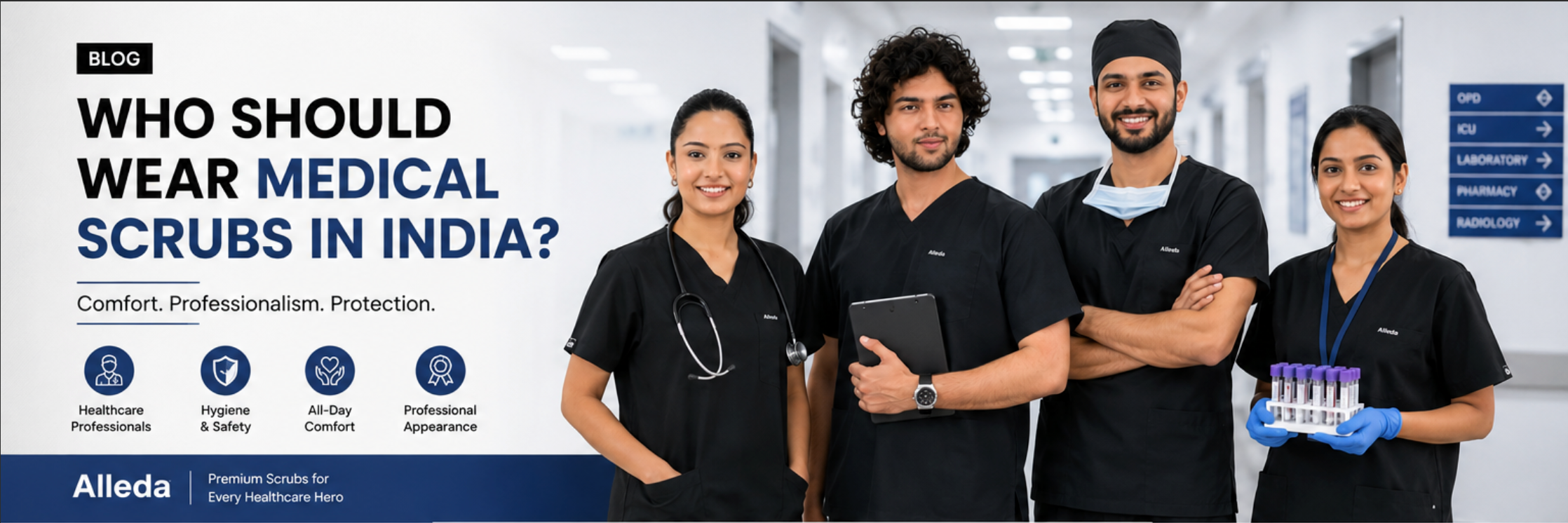
Who Should Wear Medical Scrubs in India?

Quick Answer: In India, medical scrubs should be worn by nurses, doctors, surgeons, physiotherapists, dentists, lab technicians, OT staff, paramedics, and allied health workers. Any professional who works in direct patient contact, sterile environments, or physically demanding clinical roles benefits from purpose-built medical scrubs.
The term "scrubs" once meant only one thing in Indian hospitals: the green or blue garments worn by surgical teams. That has changed completely. Across private hospitals, physiotherapy clinics, diagnostic labs, and dental surgeries throughout India, medical scrubs have become the preferred professional uniform for a wide range of healthcare roles.
If you are asking whether you — or someone on your team — should be wearing scrubs, the answer is almost certainly yes. This guide breaks down every professional category that benefits from medical scrubs in India, explains the clinical rationale behind each, and helps you understand what type of scrub suits each role.
Registered nurses in India (Indian Nursing Council, 2023)
Registered doctors in India (NMC, 2024)
Allied health professionals in India's formal sector
Comfort & mobility: top priority for clinical uniforms (WHO nursing report, 2020)
Healthcare Professionals Who Should Wear Scrubs in India
The following roles either require scrubs by hospital policy, benefit from them functionally, or have seen significant adoption as the industry standard shifts toward purpose-built clinical apparel.
🏥 Nurses & Nursing Staff
The largest group of scrub wearers in India. Scrubs allow rapid movement between wards, handle 10–12 hour shifts, and maintain infection control standards required in ICU, OPD, and general ward settings.
🩺 Doctors & Physicians
Resident doctors, interns, and hospitalists increasingly wear scrubs under or instead of the traditional white coat, particularly in surgical departments, emergency medicine, and high-patient-load wards.
🔬 Surgeons & OT Teams
The original scrub wearers. Operation theatre staff — surgeons, scrub nurses, OT technicians, and anaesthesiologists — are required to wear sterile scrubs as part of infection control protocol in every accredited hospital.
🦴 Physiotherapists
Physios perform active hands-on work: stretching, mobilisation, dry needling, and manual therapy. Scrubs with 4-way stretch fabric are essential for this role. Standard uniforms restrict movement; scrubs do not.
🦷 Dentists & Dental Hygienists
Dentists lean, bend, and work in close proximity to patients for extended periods. Scrubs provide a clean, professional appearance and reduce contamination risk better than civilian clothing.
🧪 Lab Technicians & Pathologists
Clinical lab environments involve handling biological samples and chemical reagents. Scrubs serve as a protective barrier while maintaining the professional appearance expected in hospital-attached diagnostics.
🚑 Paramedics & Emergency Staff
Ambulance crews and emergency department staff need clothing that moves fast, stays clean, and identifies them clearly. Scrubs — especially in high-visibility departmental colours — are the practical choice.
💆 Occupational Therapists
OTs work with patients on physical rehabilitation tasks throughout the day. Like physiotherapists, they require maximum mobility from their workwear across seated, floor-level, and standing positions.
🩻 Radiographers & Imaging Technicians
Staff operating X-ray, MRI, CT, and ultrasound equipment in Indian hospitals are now widely switching to scrubs as their standard uniform due to ease of movement and easy laundering protocols.
🏋️ Sports Medicine & Rehab Professionals
Sports physios, athletic trainers, and rehabilitation specialists working in clinics, sports academies, or AYUSH centres across India benefit from performance scrubs that can keep pace with active treatment sessions.
"In physiotherapy and manual therapy, your clothing cannot restrict you. I have trained over 4,000 physiotherapists across India and one consistent problem is wearing uniforms that limit the quality of hands-on techniques. A scrub built with 4-way stretch fabric is not a luxury — it is a clinical necessity for any physio performing mobilisation, dry needling, or active release therapy."— Dr. Tanmay Kumar, DPT | Founder, Alleda Scrubs | Head of Department, Capri Institute of Manual Therapy
Why Medical Scrubs Matter in the Indian Clinical Context
Why scrubs matter in Indian hospitals: Medical scrubs serve four core functions in Indian clinical environments — infection control (easy laundering at high temperatures), professional identification (colour-coded by department), physical comfort during long shifts in hot conditions, and unrestricted movement for hands-on clinical work. No civilian clothing fulfils all four requirements simultaneously.
1. Infection Control & Hygiene
The WHO State of the World's Nursing 2020 report identifies appropriate clinical attire as a baseline infection prevention measure. Medical scrubs are designed to be laundered at temperatures that eliminate common hospital-acquired pathogens. Fabric blends used in clinical scrubs — particularly polyester and rayon-based blends — dry faster, resist microbial retention better than cotton, and tolerate repeated high-temperature machine washes without degrading quickly.
In India's hospital environments, where patient volumes are high and infection control protocols are under constant regulatory scrutiny, the ability to quickly change and launder workwear is not optional — it is operationally essential.
2. Departmental Colour Coding
Most accredited private hospitals in India use a colour-coded scrub system to identify staff by department. This allows patients, visitors, and colleagues to identify roles instantly — reducing confusion in emergency situations and supporting clear clinical communication.
| Scrub Colour | Common Role / Department | Example Hospitals |
|---|---|---|
| Royal Blue / Navy | General Nursing, Staff Nurses | Apollo, Fortis, Max (varies) |
| Ceil Blue (Light Blue) | ICU Nursing, Critical Care | AIIMS-affiliated institutions |
| Surgical Green | OT Teams, Surgeons, Scrub Nurses | Standard across most hospitals |
| Maroon / Wine | Senior Nursing Officers, Ward Sisters | Apollo, Manipal, Narayana |
| Grey | Physiotherapy, Rehabilitation | Many physiotherapy departments |
| Teal / Peacock | Allied Health, OT, Radiology | Growing adoption in corporates |
| White / Off-White | Government hospitals, lab staff | Government medical colleges |
| Charcoal / Black | Hospital Administration, Management | Premium hospital networks |
3. Comfort During Long Clinical Shifts
Indian hospitals run on 8–12 hour shifts, often in environments without consistent air conditioning — particularly in tier-2 and tier-3 cities. A scrub that traps heat or restricts movement becomes a direct impediment to clinical performance. This is why fabric selection matters far more in the Indian context than it does in, say, a climate-controlled hospital in Europe.
Best scrub fabric for Indian hospitals: In India's hot and humid ward environments, a rayon-polyester-spandex tri-blend is the optimal scrub fabric. Rayon is moisture-wicking and breathable, polyester adds structural durability and shape retention through repeated washes, and spandex provides 4-way stretch for unrestricted movement. This combination outperforms pure cotton in Indian clinical conditions.
Choosing the Right Scrub for Your Healthcare Role
Not every healthcare professional has the same workwear requirement. Here is a role-by-role breakdown of what to look for when selecting medical scrubs in India.
| Role | Key Requirement | Priority Features | Recommended Alleda Line |
|---|---|---|---|
| Nurses (General Ward) | Comfort on 10–12 hr shifts | Moisture-wicking, multiple pockets, easy launder | UltraFlex |
| ICU / Critical Care Nurses | Sterile compliance, mobility | Trim fit, ceil blue available, stretch fabric | UltraFlex |
| Surgeons / OT Staff | Full sterile protocol compliance | Clean lines, no external pockets on tops, surgical green | UltraFlex |
| Physiotherapists | Unrestricted active movement | 4-way stretch, tapered fit, deep cargo pockets | UltraFlex |
| Doctors / Residents | Professional appearance + comfort | Structured collar, smart silhouette, layering-friendly | UltraFlex |
| Dentists | Clean, professional look | Moisture resistance, trim fit, easy clean | PrimaFlex |
| Lab Technicians | Protective barrier, easy launder | Durable fabric, basic pocket config, chemical-wash resistance | PrimaFlex |
| Paramedics / Emergency | Rapid movement, visibility | Stretch, durability, departmental colour compliance | UltraFlex |
| OT / Occupational Therapists | Mobility for patient handling | 4-way stretch, comfortable waistband, durable knees | UltraFlex |
| Radiographers | Professional look, ease of movement | Non-metallic closures, slim profile, moisture-wicking | PrimaFlex |
Alleda Scrubs: UltraFlex vs PrimaFlex — Which is Right for You?
Alleda Scrubs product lines: Alleda Scrubs offers two lines — UltraFlex, a premium rayon-polyester-spandex tri-blend with 4-way stretch for high-demand roles like nursing, physiotherapy, and surgery; and PrimaFlex, a 180 GSM polyester blend providing reliable everyday performance for dentists, lab staff, and outpatient roles at a mid-range price point.
| Feature | UltraFlex (Premium) | PrimaFlex (Mid-Range) |
|---|---|---|
| Fabric | Rayon + Polyester + Spandex tri-blend | 180 GSM Polyester blend |
| Stretch | 4-way stretch | Standard stretch |
| Breathability | Superior (rayon moisture-wicking) | Good |
| Shift duration | Built for 10–12 hr clinical shifts | Ideal for 6–8 hr sessions |
| Best for | Nurses, Physios, Surgeons, ICU staff | Dentists, Lab techs, Outpatient clinics |
| Price point | Premium | Mid-range |
| Wash durability | High — retains shape after 100+ washes | Good — reliable for regular laundering |
Find the Right Scrub for Your Role
Whether you're a nurse in an ICU, a physio in a rehabilitation centre, or a dentist in a private practice — Alleda has a scrub built for your clinical demands.
Are Medical Scrubs Mandatory in India? What the Regulations Say
Are scrubs mandatory in Indian hospitals? There is no single national mandate for medical scrubs across all Indian healthcare settings. However, NABH (National Accreditation Board for Hospitals) accreditation standards require hospitals to maintain documented dress code and infection control policies. Most NABH-accredited private hospitals specify scrubs or standardised uniforms for clinical staff, making them functionally mandatory in these institutions.
The National Accreditation Board for Hospitals & Healthcare Providers (NABH) sets the quality standards that India's private hospital sector follows. Under NABH infection control standards, hospitals are required to implement and enforce appropriate clinical attire policies — and for most departments, scrubs are the default solution that satisfies these requirements.
Beyond formal accreditation, there are practical workforce considerations. The Indian Nursing Council (INC) oversees professional standards for nursing in India, and most state nursing councils mandate a professional uniform as a condition of practice. In the majority of private hospitals, this requirement is fulfilled by standardised scrubs issued or specified by the employer.
What This Means for You
- If you work in a NABH-accredited hospital: Your institution almost certainly has a dress code policy that specifies scrubs. Check with your HR or infection control committee for the approved colours and specifications.
- If you work in a private clinic or smaller facility: While formal mandates may be less rigid, scrubs remain the most professionally credible and hygienically appropriate choice.
- If you are self-employed (private physiotherapist, dentist, etc.): Scrubs signal clinical authority to patients, support infection control, and make your practice look professional. They are strongly recommended even without a formal requirement.
- If you are a student or intern: Most medical colleges and nursing institutes specify a uniform that may be scrubs. When given a choice, invest in quality scrubs that you will continue to use post-qualification.
What to Look for When Buying Medical Scrubs in India
With a growing number of scrub brands entering the Indian market, the quality difference between products is significant. Here are the factors that matter most for Indian healthcare professionals.
- Fabric composition: Prioritise rayon-polyester-spandex blends for breathability and stretch. Avoid 100% cotton — it absorbs sweat, takes longer to dry, and loses shape faster in India's wash conditions.
- Stretch rating: For physically active roles (physio, nursing, surgery), you need 4-way stretch. For lighter-activity roles, 2-way stretch is adequate.
- Pocket configuration: Clinical roles require multiple pockets — chest pen pocket, side cargo pockets, back pocket. Ensure the pockets are deep enough to secure a stethoscope or tablet securely.
- Colour compliance: Purchase scrubs in your hospital's designated colour. If you are buying your own scrubs for a private practice, choose a professional clinical colour — avoid fashion-driven prints or bright patterns that reduce credibility in formal medical settings.
- Size and fit: Indian scrub sizing is not standardised across brands. Look for brands that publish detailed size charts with chest, waist, and hip measurements in centimetres. Order based on measurements, not the standard S/M/L labels.
- Washability: Indian hospital laundry runs at 60–90°C. Your scrubs must retain colour, shape, and fabric integrity through repeated high-temperature machine washes. Check the care label before purchasing.
- Durability: A single pair of scrubs that lasts 18 months costs less per shift than cheaper scrubs that need replacing every 3–4 months. Factor total cost of ownership, not just sticker price.
For a detailed sizing guide, see our post on how to choose the right scrub size in India. For women-specific scrub guidance, read our complete guide to scrubs for women healthcare professionals.
Frequently Asked Questions
Who should wear medical scrubs in India?
In India, medical scrubs should be worn by nurses, doctors, surgeons, physiotherapists, dentists, lab technicians, OT staff, paramedics, radiographers, and allied health workers. Any professional in direct patient contact, sterile environments, or physically active clinical roles benefits from purpose-built medical scrubs that support hygiene, mobility, and professional identification.
Are scrubs mandatory for nurses in India?
There is no single national mandate, but most private hospitals and NABH-accredited institutions specify a dress code that includes scrubs or standardised nursing uniforms. The Indian Nursing Council requires professional attire, and scrubs satisfy this requirement. Government hospitals may still use the traditional white uniform, though many are shifting to scrubs as well.
Can physiotherapists wear scrubs in India?
Yes, and they should. Physiotherapists perform active hands-on techniques — stretching, joint mobilisation, dry needling, and manual therapy — that require full range of motion. Scrubs made with 4-way stretch fabric, such as Alleda's UltraFlex tri-blend, are the most functional choice for physiotherapists working in clinics, hospitals, or rehabilitation centres across India.
What colour scrubs do nurses wear in Indian hospitals?
Scrub colour for Indian nurses varies by hospital. Royal blue or navy is most common for general nursing staff. Ceil blue is used in many ICUs. Surgical green is standard for OT teams. Maroon or wine often denotes senior nursing officers. Government hospitals may still use white. Always verify your hospital's colour-coding policy before purchasing.
What fabric is best for medical scrubs in hot Indian climates?
For India's hot and humid hospital environments, a rayon-polyester-spandex tri-blend is the best scrub fabric. Rayon wicks moisture and breathes better than cotton. Polyester adds durability and shape retention through repeated washes. Spandex provides 4-way stretch for clinical movement. Alleda's UltraFlex line uses this exact tri-blend, designed specifically for Indian ward conditions.
Do lab technicians in India need to wear scrubs?
Lab technicians and pathologists benefit significantly from wearing scrubs because they provide a hygienic barrier against biological samples, chemical reagents, and cross-contamination risk in clinical lab environments. Many hospital-attached diagnostic labs in India now specify scrubs as the standard uniform for all laboratory staff.
Scrubs Built for Indian Healthcare
Alleda Scrubs are designed by a physiotherapist who has trained 4,000+ clinical professionals across India. Every detail — fabric, fit, pocket placement, colour range — is built for the realities of Indian clinical environments.





Share:
Scrubs for Men (2026 Guide) | Alleda Scrubs
Best Medical Scrubs in India (2026 Buyer's Guide)